

FOR IMMEDIATE RELEASE
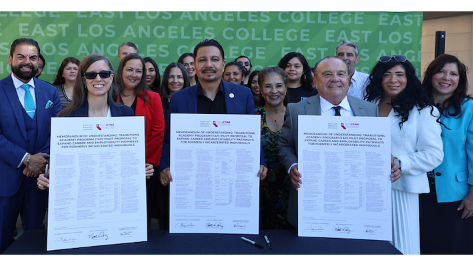
Monterey Park, CA. – East Los Angeles College (ELAC) and the California Correctional Training and Rehabilitation Authority (CALCTRA) earlier this week signed a Memorandum of Understanding formally launching the Transitions Academy Program (TAP), a two-year pilot initiative to expand career and educational pathways for individuals transitioning from incarceration.
The ceremonial signing took place during a press conference held at ELAC’s Letters/G1 Quad and was attended by Los Angeles Community College District (LACCD) Chancellor Dr. Alberto J. Román, ELAC President Dr. Monte E. Perez, and CALCTRA Director Suzie Changus, who signed the agreement on behalf of their respective institutions.
“Community colleges have the power to turn a return home into a
real opportunity to build a new future,” said Dr. Alberto J. Román,
LACCD Chancellor. “Through this partnership, ELAC is reaching
students before they are released and creating a bridge from
education and training to meaningful employment. This is about
more than preparing someone for a job. It is about creating
opportunity, strengthening families, and helping people build a
path forward. We want to see more partnerships like this across
LACCD and throughout California.”
“The Board of Trustees is proud to support partnerships that
expand opportunity while making the most of the public
resources entrusted to us,” said Sara Hernandez, J.D., President
of the LACCD Board of Trustees. “This program brings two
public agencies together around a shared goal, with a clear
commitment to measuring results and reporting back to both
governing boards. That balance of purpose and accountability is
what the Board expects from every investment we make in our students”
“ELAC has always believed that education is a right, not a
privilege reserved for a select few,” said Dr. Monte E. Perez,
ELAC President. “The Transitions Academy Program embodies
our mission to serve all learners, including those who are pre-
release or newly returning to our communities, by connecting
them with the certifications, coursework, and support they need to succeed.”
The TAP pilot will serve both pre-release participants, defined as individuals within six to twelve months of release, and post-release participants, up to one year after their release.
“Our partnership with East Los Angeles College is an innovative
and encouraging step to create a soft handoff for a formerly
incarcerated CALCTRA participant who wants to pursue and
further their educational path,” said CALCTRA’s Director Suzie
Changus. “For an individual to participate in our program, learn
a profession, and have college credits when they return to their communities that is a set up for success.”
The program aligns with the Governor’s California Career Technical Education (CTE) Master Plan and Vision 2030, emphasizing cost-effective strategies such as Credit for Prior Learning (CPL), industry certifications, entrepreneurship training, and reentry supports that lead to economic mobility.
Program offerings will include:
- Early skills and career interest assessments
- Enrollment into ELAC credit and noncredit certification programs, including a tuition-free Noncredit Career Exploration course and counseling courses such as Introduction to College and College Success Seminar
- CalMHSA-approved Peer Support Specialist training through ELAC’s Addiction Studies program
- Credit for Prior Learning (CPL) evaluations, incorporating CALCTRA’s Essential Skills for the Workforce curriculum
- Individualized transition plans and peer mentorship
- Direct connections to employer networks and work-based learning opportunities
TAP will also integrate reentry navigation services in partnership with community-based organizations and local workforce boards, offering housing navigation, transportation assistance, digital literacy support, and healthcare and mental health resource linkage. The program builds on ELAC’s existing Rising Scholars Program and will align with regional Strong Workforce Program initiatives and Workforce Innovation and Opportunity Act (WIOA) partnerships to support job readiness and placement.
Phase I of the pilot targets a launch across all 29 institutions where CALCTRA offers its Entry-to-Employment (E2E) program, with a minimum of 400 individuals engaged annually and informed about enrollment opportunities at ELAC. Roughly 40 percent of participants who complete the E2E program return to Los Angeles and surrounding counties each year.
The program is structured in three phases: program design and initial implementation, program refinement and assessment integration, and evaluation and scalability. Midyear and final reports will be shared with the governing boards of both agencies, tracking key performance indicators including enrollments, units and certificates earned, CPL credit awarded, employment placement, and reentry success.
TAP is designed as a no-cost, in-kind partnership. ELAC will fund academic programming, faculty participation, and student services through existing institutional resources, while CALCTRA will continue to provide workforce training, staffing, and infrastructure support through its standard operating budget. No funds will be exchanged between the two agencies during the pilot period. If the pilot proves successful, TAP services could be extended to community college districts across California, and an evaluation framework will help guide long-term funding strategies through local workforce boards, philanthropic partners, and state and federal grant programs.
About CALCTRA: The California Correctional Training and Rehabilitation Authority (CALCTRA) provides workforce training, education, and rehabilitation programs to incarcerated individuals across California to support successful reentry and reduce recidivism. CALCTRA provides 5,600 incarcerated individuals with life-changing career development opportunities so they may be productive, successful contributors when they return to their communities.
About East Los Angeles College: Established in 1945, East Los Angeles College is one of the largest community colleges in California, serving more than 30,000 students annually. As part of the Los Angeles Community College District, ELAC is committed to providing affordable, accessible, high-quality education and supporting student success through innovative programs and community partnerships. More information about ELAC is available online at http://www.elac.edu/.